



Glossostigma Elatinoides Care Guide | Grow a Dense Aquarium Carpet
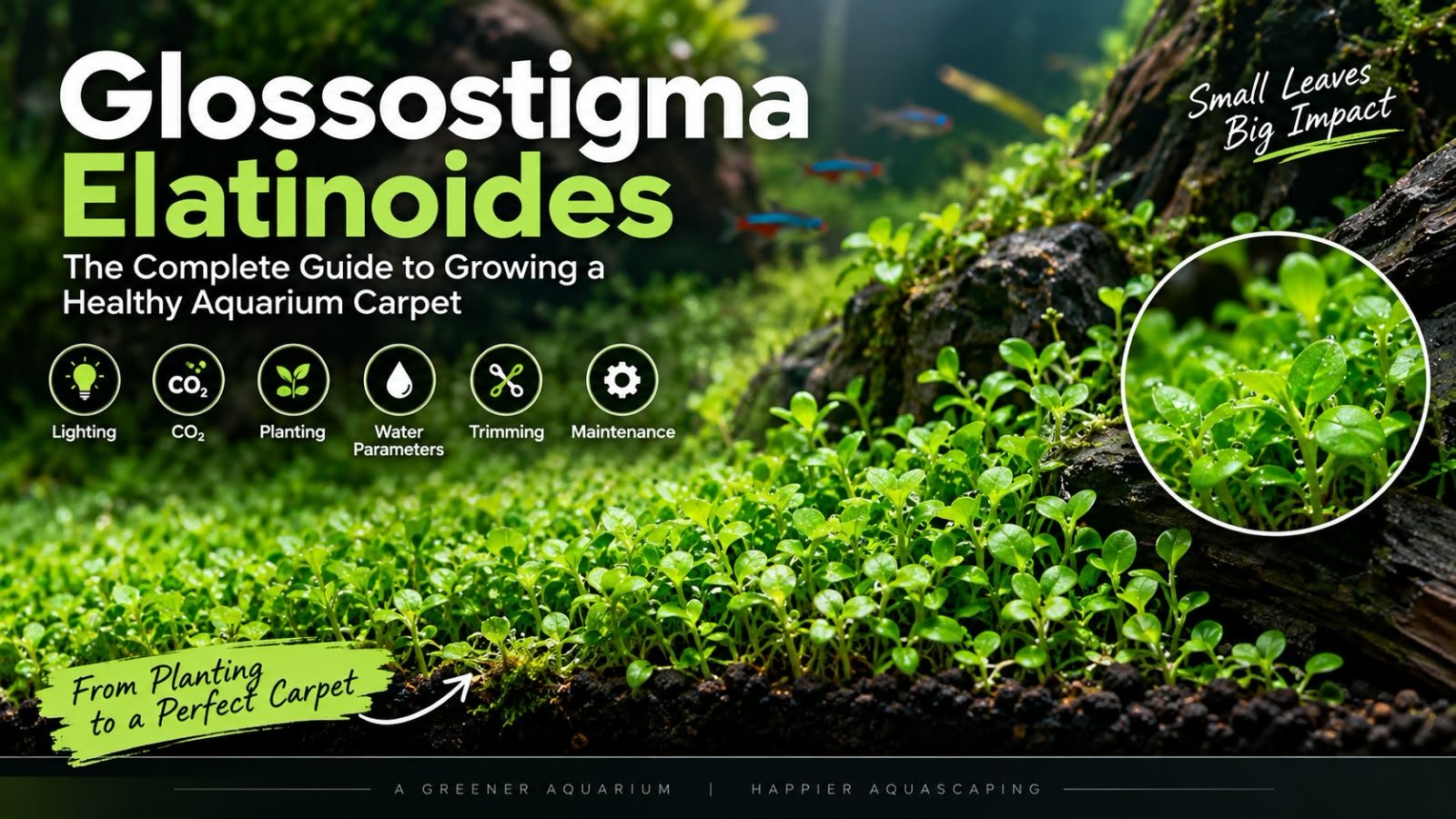
Glossostigma Elatinoides: The Complete Guide to Growing a Healthy Aquarium Carpet
Glossostigma Elatinoides: How to Grow a Dense, Healthy Aquarium Carpet
Creating a lush green carpet in the foreground of a planted aquarium is one of the most rewarding parts of aquascaping. Among the popular carpeting plants used by aquascapers, Glossostigma elatinoides, commonly called Glosso, is known for its small leaves, creeping growth, and ability to create a natural grassland-like appearance.
However, growing a healthy Glosso carpet requires more than simply planting it and switching on your aquarium light. Lighting, CO₂, planting depth, substrate, water stability, and maintenance all influence how successfully this plant spreads.
In this guide, we explain how to plant and maintain Glossostigma elatinoides, how to prevent upward growth, and how to encourage a dense foreground carpet in your planted aquarium.
What Is Glossostigma Elatinoides?
Glossostigma elatinoides is a small, fast-growing aquatic plant commonly used as a foreground carpeting plant in aquascaping.
It develops tiny rounded leaves and spreads through creeping horizontal runners. When provided with suitable conditions, these runners can gradually cover the aquarium substrate, creating a low-growing green carpet.
Key Characteristics
Feature Description
Scientific name Glossostigma elatinoides
Common name Glosso
Plant type Foreground carpeting plant
Growth pattern Creeping horizontal runners
Leaf shape Small, rounded to spoon-shaped leaves
Growth speed Fast under suitable conditions
CO₂ requirement Strongly beneficial for reliable carpeting
Lighting Moderate to high, depending on aquarium conditions
Primary use Foreground and carpet aquascaping
Glosso is particularly popular in nature-style aquascapes, minimalist layouts, and foreground compositions where a compact, vibrant green carpet is desired.
Why Is Glossostigma Popular in Aquascaping?
Glossostigma became widely associated with modern planted aquarium design, particularly the landscape-inspired approach of Nature Aquarium layouts.
Rather than leaving the foreground as an empty section of substrate, aquascapers use carpeting plants to create visual depth and connect the hardscape with the surrounding underwater landscape.
Glosso can provide:
A vibrant green foreground
A natural transition around rocks and driftwood
Greater depth in aquascaping compositions
A soft contrast against darker substrate and hardscape
A visually complete planted aquarium layout
Its small leaves and creeping growth make it especially effective when maintained close to the substrate.
How to Grow Glossostigma Elatinoides Successfully
A successful Glosso carpet depends on maintaining several conditions together. Strong lighting alone is not enough, and adding more fertilizer cannot compensate for every growing problem. Aquariums, in their infinite aquatic wisdom, refuse to follow one-button solutions.
- Provide Suitable Aquarium Lighting
Lighting plays an important role in encouraging Glossostigma to grow horizontally.
When the plant receives insufficient light, it may begin growing upward as it attempts to reach a stronger light source. This can produce a taller, less compact appearance instead of the low carpet most aquascapers want.
Lighting Tips
Use lighting appropriate for a planted aquarium.
Ensure the foreground receives sufficient light.
Avoid excessive shading from taller plants.
Consider aquarium depth and light distribution.
Monitor plant growth rather than relying only on light specifications.
Important: Light requirements vary depending on aquarium depth, water clarity, plant density, light efficiency, and CO₂ availability.
A strong light does not automatically guarantee success if other growing conditions are unsuitable.
- CO₂ Helps Glossostigma Spread
Glossostigma can survive without injected CO₂ in some aquarium setups, but achieving a dense, consistent carpet is generally more demanding without it.
Injected CO₂ can support faster growth and improve the plant’s ability to spread under suitable lighting and nutrient conditions.
Why CO₂ Matters
Aquatic plants use carbon for photosynthesis. In a planted aquarium, available carbon can influence growth, particularly when lighting and plant demand are high.
For a more reliable Glosso carpet:
Maintain consistent CO₂ availability.
Avoid sudden fluctuations.
Ensure adequate circulation throughout the aquarium.
Match CO₂ levels with lighting intensity and plant demand.
Monitor livestock carefully when adjusting CO₂.
Consistency is more important than constantly changing settings.
Sudden changes in CO₂ concentration can stress plants and aquatic animals. Always adjust gradually and observe aquarium inhabitants.
- Plant Glossostigma Horizontally
One of the most common mistakes when planting Glosso is placing the entire plant too deeply or planting large clumps without separating them.
Glossostigma spreads through runners. Proper planting encourages these runners to establish and move across the substrate.
Recommended Planting Method
- Separate the plant into small portions.
- Remove excess growing medium carefully, when applicable.
- Use aquarium tweezers for accurate planting.
- Insert the roots into the substrate.
- Keep the leaves above the substrate.
- Leave small gaps between portions.
- Plant the portions across the foreground.
Avoid burying the entire plant. The roots should be secured while the leaves remain exposed.
Why Small Portions Work Better
Small portions allow the plant to spread from multiple points across the foreground. Large clumps may rot internally, detach, or prevent runners from establishing evenly.
Patience is essential. A carpet is grown through repeated small successes, not by aggressively burying half the plant and hoping nature files a complaint.
The Best Substrate for Glossostigma
Glossostigma can grow in different planted aquarium substrates, provided the substrate supports root development and remains suitable for planting.
A good substrate should allow:
Root establishment
Stable planting
Adequate water movement around the roots
Nutrient availability
Easy replanting when maintenance is required
Aquasoils are commonly used in planted aquariums because they can support plant growth and provide a suitable medium for rooting.
Substrate Considerations
When selecting substrate, consider:
Grain size
Rooting depth
Nutrient content
Compaction
Compatibility with your aquarium setup
Avoid excessively compacted substrate, which can make planting and root development more difficult.
Can Glossostigma Grow Without CO₂?
Yes, Glossostigma may grow without injected CO₂, but carpeting can become slower and more challenging.
The result depends on several factors, including:
Lighting intensity
Aquarium depth
Plant density
Water movement
Nutrient availability
Carbon availability
Overall aquarium stability
Shallow aquariums with suitable lighting may provide more favourable conditions, but there is no universal guarantee that Glosso will form a dense carpet without CO₂.
If your goal is a fast, compact, and consistently spreading carpet, injected CO₂ can make the process more manageable.
Water Parameters for Glossostigma Elatinoides
Glossostigma can tolerate a range of aquarium conditions. Rather than chasing a perfect number, focus on stable and appropriate parameters.
General considerations include:
Parameter Practical Consideration
pH A stable, suitable planted-aquarium range
Temperature Compatible with the plant and livestock
Water hardness Depends on the overall aquarium setup
Nutrients Consistent availability without excessive dosing
CO₂ Stable availability when injected
Water changes Regular maintenance based on aquarium needs
The exact ideal conditions may vary with the aquarium’s livestock, other plants, substrate, and maintenance routine.
Stable conditions are usually more valuable than frequent parameter changes.
Why Is Glossostigma Growing Upward?
Vertical growth is one of the most common concerns among aquascapers growing Glosso.
Instead of spreading across the substrate, the plant may begin growing upward, creating taller stems and a loose appearance.
Possible Causes
- Insufficient Light at the Foreground
If the foreground receives inadequate light, Glosso may grow upward rather than remain compact.
- Shading From Other Plants
Tall stem plants, floating plants, or hardscape structures can block light from reaching the carpet.
- Poor Planting Technique
Plants that are planted too deeply, loosely, or in large clumps may struggle to establish correctly.
- Inconsistent CO₂
Fluctuating CO₂ availability can make growth less predictable, particularly in high-light aquariums.
- Crowded Growth
A dense or overgrown carpet may require trimming and replanting to maintain healthy spreading.
- Nutrient Imbalance
Nutrient availability can influence plant growth, but vertical growth should not automatically be treated as a fertilizer deficiency.
What Should You Check First?
Before adding more fertilizer, evaluate:
Planting depth
Light reaching the foreground
Shading
CO₂ consistency
Water circulation
Plant density
Overall aquarium stability
A structured diagnosis is more useful than randomly adding nutrients and hoping the aquarium develops supernatural problem-solving skills.
How to Trim Glossostigma
Regular maintenance helps prevent the carpet from becoming too tall, congested, or uneven.
When Glossostigma grows densely, older sections may shade lower leaves and reduce circulation within the carpet.
Trimming Tips
Use clean, sharp aquascaping scissors.
Trim overgrown sections carefully.
Remove detached or decaying plant material.
Avoid disturbing the substrate unnecessarily.
Replant healthy runners where coverage is thin.
Perform maintenance gradually rather than removing the entire carpet.
Trimming should help maintain the intended carpet height while allowing healthy portions to continue spreading.
How to Replant Glossostigma Runners
When Glosso sends runners upward or grows beyond the desired area, healthy sections can often be cut and replanted.
Replanting Steps
- Identify healthy sections with established roots.
- Cut the runner cleanly.
- Separate the portion into manageable pieces.
- Plant each piece horizontally or close to the substrate.
- Secure the roots without burying the leaves.
- Leave enough space for future spreading.
Replanting allows you to improve coverage and maintain a more uniform foreground.
Common Glossostigma Growing Mistakes
Avoiding common mistakes can improve your chances of establishing a healthy carpet.
Mistake 1: Planting Large Clumps
Large portions can struggle to establish evenly and may develop dead material inside the clump.
Better approach: Divide the plant into smaller portions.
Mistake 2: Planting Too Deeply
Burying the leaves can restrict growth and increase the risk of deterioration.
Better approach: Secure the roots while keeping the leaves exposed.
Mistake 3: Ignoring Foreground Lighting
The aquarium may appear bright overall while the substrate remains shaded.
Better approach: Evaluate light distribution at the actual carpet level.
Mistake 4: Changing CO₂ Frequently
Constant adjustments can create unstable growing conditions.
Better approach: Aim for consistent CO₂ delivery and monitor livestock.
Mistake 5: Adding Fertilizer Without Diagnosis
Not every growth problem is caused by a nutrient deficiency.
Better approach: Check light, planting, CO₂, shading, and water stability first.
Mistake 6: Neglecting Maintenance
A carpet that becomes too dense or tall can lose its compact appearance.
Better approach: Trim and replant as needed.
Glossostigma Maintenance Checklist
Use this checklist when establishing or maintaining your aquarium carpet.
Planting
[ ] Plant in small portions.
[ ] Keep leaves above the substrate.
[ ] Secure roots properly.
[ ] Leave room for horizontal spreading.
Lighting
[ ] Ensure the foreground receives sufficient light.
[ ] Reduce excessive shading.
[ ] Observe growth patterns over time.
CO₂
[ ] Maintain consistent availability when injected.
[ ] Avoid sudden fluctuations.
[ ] Monitor fish and shrimp carefully.
Water and Nutrients
[ ] Maintain stable water conditions.
[ ] Provide appropriate nutrients.
[ ] Avoid unnecessary dosing changes.
Maintenance
[ ] Trim overgrown sections.
[ ] Remove decaying material.
[ ] Replant healthy runners.
[ ] Maintain even carpet coverage.
Is Glossostigma Elatinoides Suitable for Beginners?
Glossostigma can be rewarding for beginners who are willing to monitor their aquarium and maintain consistent conditions. However, it may be more demanding than some slower-growing or lower-light carpeting plants.
It is particularly suitable for aquascapers who want to learn about:
Planting techniques
CO₂ management
Foreground lighting
Aquatic plant trimming
Carpet maintenance
Aquarium balance
For beginners, starting with a suitable aquarium setup and realistic expectations is important. A dense carpet may take time to establish, and growth speed will vary between aquariums.
Buy Glossostigma Elatinoides for Your Planted Aquarium
Bring a vibrant green foreground to your aquascape with Glossostigma elatinoides.
This compact carpeting plant is suitable for aquascapers looking to create natural-looking foregrounds, landscape-inspired layouts, and dense planted aquarium carpets.
Before purchasing, make sure your aquarium provides suitable:
Lighting
CO₂ availability
Substrate
Water conditions
Maintenance support
With proper planting and consistent care, Glossostigma can become an attractive foundation for your planted aquarium design.
Shop Glossostigma Elatinoides and start building your underwater landscape.
Frequently Asked Questions
- Does Glossostigma need CO₂?
No aquarium setup is identical, but injected CO₂ generally makes it easier to achieve faster and more consistent carpeting growth.
- Why is my Glossostigma growing vertically?
Possible factors include insufficient foreground lighting, shading, planting issues, inconsistent CO₂, and crowded growth.
- How should I plant Glossostigma?
Separate the plant into small portions and plant the roots into the substrate while keeping the leaves exposed.
- Can I grow Glosso in low light?
It may survive in lower-light conditions, but achieving a dense, compact carpet can be more difficult.
- How often should I trim Glossostigma?
Trim when the carpet becomes too tall, dense, or uneven. The frequency depends on growth speed and aquarium conditions.
- Is Glossostigma suitable for nano aquariums?
It can be used in suitable nano aquariums, especially shallow layouts with appropriate lighting and maintenance. Consider the aquarium’s depth and available growing space.
- Can Glossostigma grow in nutrient-rich aquasoil?
Yes, aquasoil can provide a suitable planting medium. Nutrient requirements depend on the complete aquarium setup and maintenance routine.
Suggested Product Categories
CO₂ Aquarium Plants


